
On the Identity of the Two Witnesses
Interpretive Proposal
The Two Witnesses as the Living Word
Old and New Testaments
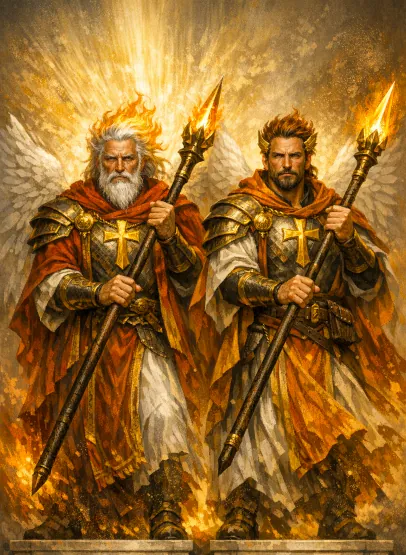
This study proposes that the Two Witnesses of Revelation 11 are the Word Himself, expressed in dual, Spirit-empowered forms, symbolizing the unified testimony of God’s Word through the Old and New Testaments.
It presents one possible understanding of the Two Witnesses based on the biblical text.
While this may differ from traditional interpretations, its purpose is not to oppose them but to explore what the Scriptures themselves reveal.
The conclusions presented here are open to refinement, offered with the understanding that further insight — whether through deeper study or divine revelation — may bring greater clarity.
This Proposal
The Two Witnesses of Revelation 11 may represent the twofold testimony of Scripture — the Old Testament and the New Testament functioning together as the unified, living Word of God.
Their prophetic ministry reflects the complete witness of the Word: partially fulfilled through the earthly ministry of Jesus and completed through the ministry of the Two Witnesses, who manifest the Word Himself in dual expressions before God.
This proposal is grounded in Scripture alone.
Any symbolic associations presented are offered as interpretive supports rather than doctrinal assertions, and the conclusions remain provisional, open to refinement through further study and discernment.
This proposal understands the “death” of the Two Witnesses in covenantal terms, expressed not as humans but as the Word Himself. Hebrews 9 explains that covenantal testimony is enacted through death (Hebrews 9:16), framing death not merely as biological cessation but as the moment when covenantal authority is activated, continuing what the Word began in Christ’s earthly ministry. This provides the theological framework for interpreting the death and vindication of the Two Witnesses in Revelation 11:7–13.
With this covenantal framework in place, first consider Jachin and Boaz, the pillars of Solomon’s Temple. These pillars are considered here as symbolic supports that mirror the dual structure of Scripture, representing dual expressions of the one Word. Standing at the entrance of the Temple, they served as signs of God’s covenantal stability and testimony, making them fitting metaphors for the twofold foundation upon which the entirety of biblical revelation rests.
The Two Witnesses stand as heavenly pillars of the Word Himself. Jachin, meaning “He will establish,” emphasizes the sustaining foundation and divine order revealed in Scripture, while Boaz, meaning “In Him is strength,” reflects God’s power and covenantal stability. Together, these symbolic names reinforce the dual expression of the Word: two forms, yet one unified testimony of God’s covenantal revelation, symbolizing the continuation of covenantal testimony begun in Christ’s earthly ministry.
Consider: Two pillars, one Temple; two Testaments, one Word.
The Old Testament emphasizes:
• God’s mighty acts
• Law
• Power
• Covenant enforcement
The New Testament emphasizes:
• Fulfillment
• New covenant
• Establishment of the Church in Christ
Meaning of the names Jachin and Boaz
Jachin (“He establishes”) and Boaz (“In Him is strength”) symbolize the complementary functions of divine testimony: God establishes and God strengthens.
Boaz (בֹּעַז)
• Meaning: “In Him is strength” or “By His strength.”
• Symbolism: Represents God’s power, stability, and sustaining strength.
• Symbolic association: Suggested here as a representation of the Old Testament.
Jachin (יָכִין)
• Meaning: “He will establish” or “He establishes.”
• Symbolism: Represents God’s establishing work, covenant order, and divine foundation.
• Symbolic association: Suggested here as a representation of the New Testament.
These pillars symbolically reflect the dual testimony of Scripture: not merely two separate witnesses, but two complementary expressions of God's covenantal purpose — established by Him and sustained by His strength.
Alternative Symbolic Identities
Let’s consider an alternative symbolic representation. Because the Two Witnesses act as covenantal agents, we can identify another expression of this dual testimony in the Old and New Testaments. I propose the Angel of the Lord (OT) and Jesus’ angel (NT).
In Scripture, these figures act as direct messengers of God’s Word, exercising divine authority and bearing covenantal testimony. The Angel of the Lord often appears in the Old Testament as a visible manifestation of God’s presence and judgment, while Jesus’ angel delivers revelation and guidance in the New Testament context (Revelation 1:1). Together, these two agents embody the dual expression of the Word, acting as heavenly witnesses who continue the testimony that Christ began in His earthly ministry. This perspective complements the symbolic pillar imagery, emphasizing that the Word’s witness can be expressed through both written and embodied, Spirit-empowered forms.
This study is not attempting to identify specific, named individuals or entities from Scripture as the Two Witnesses. Revelation does not provide explicit identities for them, and it is entirely possible that they are unnamed or unknown heavenly beings. Even so, the idea that they may function as heavenly agents — true representatives of the Word of God — is both plausible and scripturally coherent. This proposal does not insist upon such an identity, but simply explores it as one interpretive possibility within the biblical framework.
Whoever they are, Scripture does not require them to be human agents.
Scriptural Foundations for the Word as a Witness
Key scriptural elements that form a coherent foundation for this concept:
- Jesus as the Word and the Faithful Witness
- John 1:1 identifies Jesus as the eternal Word made flesh.
- Revelation 1:5 calls Him the “faithful witness.”
- Jesus’ earthly ministry lasted 3.5 years, marked by proclamation, rejection, death, and resurrection.
- This pattern parallels the ministry of the Two Witnesses in Revelation 11.
Together, these elements establish a foundation for viewing the Two Witnesses not merely as individuals, but as a continuation of the testimony of the Word — the same witness Jesus embodied, now expressed through the dual structure of Scripture.
- The Two Witnesses as the Continuing Testimony of the Word
- Revelation 11:3 describes the Two Witnesses prophesying for 1,260 days (3.5 years).
- Their ministry mirrors Jesus’ pattern of rejection, death, and resurrection.
- Jesus’ 3.5‑year ministry + the Witnesses’ 3.5‑year ministry = a complete seven‑year testimony.
- This corresponds to the final “week” of Daniel 9:27.
This continuity supports the idea that the Two Witnesses represent the ongoing testimony of the Word, completing what Jesus began and fulfilling the prophetic structure laid out in Scripture.
This pattern becomes even clearer when viewed through the prophetic structure of Daniel’s 70th week, which provides the chronological framework for understanding the Two Witnesses. The Messiah’s earthly ministry, lasting 3.5 years, fulfilled the first half of this final week, but as Daniel 9:26–27 notes, He was “cut off,” leaving the second half unfulfilled. The Two Witnesses appear at precisely this midpoint, functioning as Spirit-empowered embodiments of the Word Himself — not as incarnations, but as covenantal agents — to complete the remaining 3.5 years.
Their ministry mirrors Christ’s pattern of proclamation, rejection, death, and vindication, completing the missing portion of God’s prophetic timeline and fulfilling what was foreshadowed in Daniel and brought into history in Christ.
Integrated Theological Foundation
Old Testament
The biblical pattern of dual, Spirit‑empowered testimony is understood in this study as arising from the nature of the Word. Scripture consistently presents the Word as God’s primary witness: God “magnifies His Word together with His name” (Psalm 138:2), Christ interprets “all the Scriptures” as testifying of Himself (Luke 24:27), and He declares that these writings “testify of Me” (John 5:39).
The Word is “living and active” (Hebrews 4:12) and is embodied in Christ, who “became flesh and tabernacled among us” (John 1:14).
Within this scriptural witness, the Old and New Testaments function covenantally as a dual testimony, and Deuteronomy 19:15 establishes the principle that covenantal matters are confirmed “by the mouth of two or three witnesses.” This provides the conceptual basis for reading Scripture’s testimony as structurally dual in expression.
This dual‑witness structure is therefore best understood as grounded in the nature of the Word as Scripture itself attests, which God has exalted and empowered as His authoritative testimony in the world.
Having established the structural basis of dual covenantal testimony in Scripture, the New Testament deepens and fulfills this pattern in its covenantal and eschatological dimensions.
Integrated Theological Foundation
New Testament
Within this covenantal framework, the New Testament deepens the pattern by showing that covenantal realities involve death, inauguration, and heavenly correspondence. Hebrews 8–10 explains that earthly structures mirror heavenly ones, and that covenantal enactment involves death (Hebrews 9:16), providing a theological basis for understanding the death and vindication of the Two Witnesses in Revelation 11:7–13. Their ministry mirrors Christ’s own witness and fulfills the prophetic command that “you must prophesy again before many peoples, nations, tongues, and kings” (Revelation 10:11).
Within this framework, the Two Witnesses may be understood as the dual covenantal testimony of the Word — the Old and New Covenants functioning together as God’s Spirit-empowered witness — whose death, resurrection, and ascension reflect the covenantal pattern revealed in Christ and extended through redemptive history through a unified twofold witness.
Revelation 11 also places the Two Witnesses within a temple context. John first sees the temple of God and then identifies the witnesses as the two olive trees and two lampstands standing before the Lord. This imagery draws from Zechariah 4, where the lampstand and olive trees represent Spirit-supplied testimony associated with God's covenant purposes.
The Two Candlesticks and the Spirit-Empowered Testimony
Building on the chronological and prophetic framework of Daniel’s 70th week, John’s vision in Revelation 11 presents the Two Witnesses as “the two lampstands” (Revelation 11:4). Revelation itself establishes lampstands as symbols of Spirit-empowered, covenantal witness: in Revelation 1:20, Jesus explains that “the seven lampstands are the seven churches,” linking the imagery of light with faithful testimony in the world.
Just as the Two Witnesses complete the second 3.5-year half of Daniel’s final week, the two lampstands function as visible symbols of God’s Word shining through His covenant people. Their ministry is not merely human but divine, Spirit-empowered and covenantal in nature, reflecting the ongoing testimony of the Word. This symbolic pairing mirrors the dual structure of Scripture — Old and New Testaments — providing a unified witness that carries forward what Christ began in His earthly ministry.
This imagery is not new; Revelation builds on a pattern first introduced in Zechariah 4, where one lampstand is supplied by two olive trees.
Building on Zechariah 4, where one lampstand is supplied by two olive trees, John expands the imagery: the Two Witnesses are both ‘the two olive trees and the two lampstands standing before the Lord of the earth’ (Revelation 11:4), emphasizing the dual, Spirit-empowered expression of the one unified Word. Together, the lampstands and olive trees visually depict the continuity, completeness, and covenantal authority of God’s testimony across history.
Through this imagery, the lampstands communicate not only witness but also illumination — the Word of God shining visibly through His covenant people.
Supporting Patterns and Parallels
Jesus and the Two Witnesses operate within the same prophetic framework: a 3.5‑year ministry marked by proclamation, rejection, death, and resurrection.
Together, they complete the seven‑year testimony anticipated in Daniel’s final “week.”
The symbolic identifiers introduced earlier — whether Jachin and Boaz or the Angel of the Lord and Jesus’ angel — underscore the twofold nature of this witness, reflecting the Old and New Testaments as a unified expression of God’s Word.
The Two Candlesticks
Revelation itself interprets candlesticks as churches.
In Revelation 1:20, Jesus explains that “the seven candlesticks are the seven churches,” establishing candlesticks as symbols of Spirit‑indwelt, covenantal witness in the world. Revelation 11 singles out the Two Witnesses as “the two candlesticks,” placing them within this symbolic category — not as isolated individuals, but as Spirit‑empowered extensions of God’s Word, continuing the covenantal testimony Christ began in His earthly ministry while remaining connected to His people.
Although the Temple did not contain two literal candlesticks functioning as paired witnesses, the two candlesticks in Revelation 11 and the two pillars, Jachin and Boaz, share a unified symbolic function: both stand as paired witnesses before God, visually representing the dual testimony of divine revelation — one corresponding to the Old Testament, the other to the New.
Together, the two candlesticks in Revelation and the two pillars in the Temple signify the continuity of God’s covenantal Word, linking the prophetic ministry of the Two Witnesses to the historic foundation of Scripture.
The Two Olive Trees / The Two Anointed Ones and the Unified Testimony of the Word
Consider: Two sources of oil, one lampstand; two Testaments, one unified witness.
Zechariah’s vision provides the foundational imagery that Revelation 11 later develops and expands.
In Zechariah 4:2–3, the prophet sees one lampstand with seven lamps, supplied continuously by two olive trees. The lampstand represents God’s illuminated people, while the olive trees symbolize the Spirit’s anointing. Zechariah 4:11–14 identifies these trees as “the two anointed ones,” standing before the Lord.
This pattern establishes a symbolic structure:
• One lampstand — a single, unified witness
• Seven lamps — later representing the seven churches
• Two olive trees — two Spirit‑given sources of testimony
Revelation takes this imagery and intensifies it. The Two Witnesses are described as “the two olive trees and the two candlesticks standing before the God of the earth” (Revelation 11:4). What Zechariah presents as two sources feeding one lampstand, John presents as two Spirit‑empowered witnesses bearing one unified testimony — the testimony of the Word.
Consider again: two Witnesses, one Spirit‑empowered testimony — two sources of oil, one lampstand; two Testaments, one Word.
Zechariah’s vision becomes the symbolic backbone for Revelation’s imagery.
In Revelation 11, the two olive trees reappear — now paired with two candlesticks — to depict the twofold, Spirit‑empowered expression of God’s unified Word.
John’s vision intensifies Zechariah’s pattern. Rather than one lampstand supplied by two olive trees, he sees two candlesticks alongside two olive trees, highlighting the paired structure through which the Old and New Testaments together bear a single, unified witness.
This relationship can be further clarified as follows:
Zechariah’s vision in Zechariah 4 provides the symbolic foundation later drawn upon in Revelation 11. The two olive trees, identified as “the two anointed ones” who stand by the Lord of the whole earth (Zechariah 4:14), represent divinely authorized testimony sustained by the Spirit rather than by human power (Zechariah 4:6).
Importantly, the vision presents one lampstand continually supplied by two olive trees. The light is one; the supply is twofold. This establishes a pattern of unified testimony expressed through a paired witness.
In Revelation, candlesticks represent churches (Revelation 1:20), so John’s reuse of Zechariah’s imagery extends Spirit‑empowered testimony into the life of the Church.
Revelation 11 intensifies the pattern: the Two Witnesses are “the two olive trees and the two lampstands standing before the Lord of the earth” (Revelation 11:4). This expansion highlights the dual form of the witness while preserving its unity. As Revelation 19:10 affirms, “the testimony of Jesus is the spirit of prophecy,” grounding this dual witness in the unified testimony of the Word.
The Two Witnesses also mirror Christ’s three and a half year ministry, death, resurrection, and ascension (Revelation 11:7–13), reinforcing the covenantal continuity and redemptive significance of their testimony.
Within this framework, the two olive trees may be understood as the Old and New Testaments — distinct in form and historical role, yet inseparable in function — together supplying the light of the one Word of God. The same Spirit that empowered the testimony in Zechariah continues to sustain this unified witness, keeping the Word living, active, and enduring across generations.
Functionally, the olive trees and candlesticks in Revelation perform the same covenantal role as the historical temple pillars: they are Spirit‑empowered witnesses of God’s Word. Revelation thus transforms Zechariah’s imagery into a vision of the enduring, unified testimony of God, continually illuminated and sustained by the Spirit.
A Possible Scriptural Motif
Does this pattern — two sources bearing one unified, Spirit-empowered testimony — appear not only symbolically, but also narratively throughout Scripture? Might this same dual pattern manifest elsewhere in the form of heavenly beings acting as witnesses?
While no passage explicitly identifies these angelic figures as the same two individuals, several pivotal moments in Scripture feature the recurring presence of two heavenly figures which could, in theory, be the same pair (Genesis 19:1-22; Matthew 28:3-5; Mark 16:5-6; Luke 24:3-7; Luke 24:22-23; John 20:12-13; Act 1:10-11).
This repeated pattern does not establish their identity, nor does it directly connect them to the Two Witnesses of Revelation 11. However, the consistency of two witnesses appearing at decisive moments in salvation history leaves open the possibility that they reflect a deeper, unified witnessing motif woven throughout Scripture.
Such a view remains speculative but permissible, offering a thematic extension rather than a conclusion demanded by the text.
The Principle of Two Witnesses
A Principle Affirmed by Christ
This study has shown that Scripture consistently employs the principle of two witnesses as God's ordained pattern for establishing covenantal truth. The Two Witnesses of Revelation therefore appear not as an isolated mystery, but as the climactic expression of a pattern woven throughout Scripture.
Jesus Himself appeals to the biblical requirement for two witnesses:
"It is also written in your law, that the testimony of two men is true. I am one that bear witness of myself, and the Father that sent me beareth witness of me." (John 8:17–18)
Here Jesus applies the legal principle established in Deuteronomy 19:15 to God's own revelation. Jesus affirms the requirement for two witnesses by presenting the testimony of the Father and the Son as the divine confirmation of His identity and mission.
This demonstrates that the biblical pattern of two witnesses is not merely judicial but also theological, serving as God's ordained means of confirming His covenantal truth. It is not limited to prophetic imagery or narrative symbolism but reflects a divine principle governing the confirmation of truth.
Rather than setting aside the principle established in Deuteronomy 19:15, He applies it to His own divine mission, presenting the testimony of the Father and the Son as the ultimate application of the Law's requirement. The pattern therefore spans both covenants, not as an arbitrary detail, but as the climactic expression of God's established principle of confirmed testimony.
Also see Matthew 18:16; 2Corinthians 13:1; Deuteronomy 17:6; Hebrews 10:28
The Father and the Son together bear unified testimony concerning the revelation of God. This places the dual-witness pattern at the center of the gospel and provides an interpretive backdrop for understanding the Two Witnesses of Revelation within the same covenantal framework of confirmed testimony.
Related passages: Matthew 18:16; 2 Corinthians 13:1; Deuteronomy 17:6; Hebrews 10:28.
Tapestry: The Enduring Witness of God’s Word
The symbolic and covenantal imagery woven throughout Scripture — the candlesticks, olive trees, pillars, and anointed ones — converges into a single, compelling truth: God’s Word stands as His enduring witness in the world.
Throughout history, His testimony has often been mediated through agents who speak, act, and represent Him, not limited to ordinary human prophets. From Zechariah’s vision to John’s Revelation, the pattern is consistent: the Old and New Testaments together form a Spirit‑empowered, dual testimony that cannot be silenced, rejected, or extinguished.
What began in the prophets and was embodied in Christ continues through Scripture itself — shining through the churches and upheld by the Spirit.
In this light, the Two Witnesses of Revelation 11 may be understood not merely as two isolated prophets, but as the unified, dual testimony of God’s Word — embodied in Christ and written in Scripture.
This testimony is reflected symbolically in candlesticks, pillars, olive trees, and even angelic messengers, bearing witness to His covenantal presence across generations.
While some interpretations identify the Two Witnesses as literal historical figures, the broader biblical pattern emphasizes covenantal testimony empowered by the Spirit. As Hebrews 9:12 shows, covenant is enacted through sacrificial death, and Revelation 11’s imagery of candlesticks, olive trees, and Spirit-empowerment reflects this principle. This perspective does not deny historical witnesses but recognizes that the ultimate, enduring testimony is God’s unified Word.
The imagery of the temple pillars and the Two Witnesses reveals a recurring biblical pattern: God's covenant testimony stands before Him and before the world. What He establishes, He strengthens; what He appoints, He preserves. Though opposed and even appearing defeated, His testimony is ultimately vindicated by God Himself.
Thus, the Two Witnesses may be understood as two distinct entities whose joint, Spirit-empowered testimony conveys the unified Word of God — rooted in the Old and New Testaments, sustained by the Spirit, and continuing the covenantal witness of God throughout history. This witness reflects the testimony entrusted to God's people, now expressed through them alongside the 144,000 and the faithful remnant who endure even through martyrdom.
Summary List of Scripture References
This reference list has been reorganized by theological theme rather than page order or biblical sequence, reflecting the interconnected patterns explored throughout this study.
The Word of God as Living Testimony
- Psalm 138:2 — God magnifies His Word together with His name
- Luke 24:27 — Christ interpreting Scripture as testimony
- John 5:39 — “These are they which testify of Me”
- John 1:14 — The Word became flesh and “tabernacled” among us
- Hebrews 4:12 — Scripture’s self-testimony as “living and active”
- Revelation 1:1 — The revelation of Jesus Christ and His authority as the source of divine revelation
- Revelation 19:10 — “The testimony of Jesus is the spirit of prophecy”
The Biblical Principle of Two Witnesses
- Deuteronomy 17:6 — “At the mouth of two witnesses, or three witnesses, shall he that is worthy of death be put to death”
- Deuteronomy 19:15 — “By the mouth of two or three witnesses”
- Matthew 18:16 — “the mouth of two or three witnesses every word may be established”
- 2 Corinthians 13:1 — “the mouth of two or three witnesses shall every word be established”
- John 8:17–18 — “I am one that bear witness of myself, and the Father that sent me beareth witness of me”
- Hebrews 10:28 — “died without mercy under two or three witnesses”
- 1 John 5:9 — “If we receive the witness of men, the witness of God is greater...”
Covenant, Testament, and Death
- Hebrews 8–10 — Earthly structures as reflections of heavenly realities; covenantal testimony involving death and fulfillment
- Hebrews 9:16 — Covenant enacted through death, framing the Witnesses’ “death” in Revelation 11
The Two Olive Trees and Spirit-Empowered Witness
- Zechariah 4:2–3 — Vision of the lampstand and olive trees
- Zechariah 4:6 — “Not by might, nor by power, but by My Spirit.”
- Zechariah 4:11–14 — Identification of the “two anointed ones”
Temple Pillars and Dual Testimony
- 1 Kings 7:21 — Construction of Solomon’s Temple, including Jachin and Boaz
- 1 Kings 7:49 — Description of Temple furnishings and pillars
- 2 Chronicles 4:7 — Further details on the pillars and Temple structure
The Lampstand Pattern
- Exodus 25:31–40 — Instructions for the golden lampstand in the Tabernacle
- Exodus 37:17–24 — Construction of the lampstand according to God’s design
- Revelation 1:12 — John’s vision of the seven golden lampstands
- Revelation 1:20 — Explanation of the lampstands and stars
The Prophetic Framework of the Two Witnesses
- Daniel 9:27 — Frames the prophetic “final week,” completing the seven-year testimony that Jesus began and the Witnesses continue
- Revelation 10:11 — “Thou must prophesy again before many peoples, and nations, and tongues, and kings”
- Revelation 11:3–4 — The Two Witnesses’ 1,260-day ministry, echoing Christ’s 3.5-year pattern
- Revelation 11:7–13 — Death, resurrection, and ascension into heaven
Last updated: July 24, 2026